
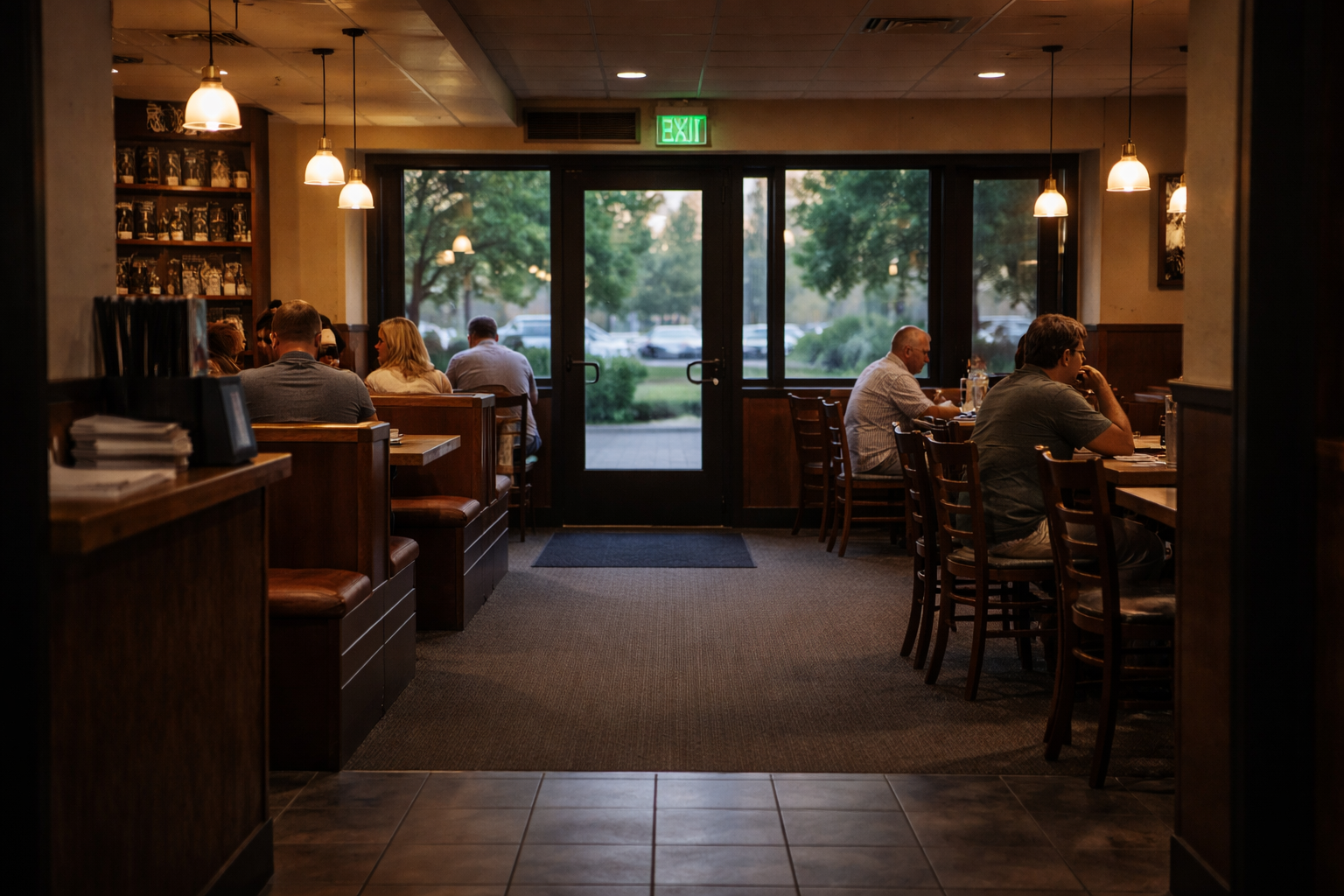
Next time you walk into a restaurant, pay attention to what you do before you sit down. Most people follow the host to a table, pull out a chair, and sit. They haven’t looked at the room. They don’t know where the exits are, who else is in the space, or whether the seat they just took puts their back to the door.
It takes about ten seconds to do this right. Most people never do it at all.
Why It Matters
Your position in a room determines your options. Where you sit affects what you can see, who can approach you without warning, how quickly you can move if you need to, and how much of the space you control versus how much controls you.
This is not a concept unique to high-threat environments. It applies to a family dinner, a coffee meeting, a waiting room at the doctor’s office. The habit is the same regardless of context. You walk in, you take ten seconds, you choose your position deliberately instead of by default.
Most people sit wherever they’re pointed. That’s fine most of the time. The problem is that it’s always fine until the one time it isn’t, and by then the habit either exists or it doesn’t.
What to Look For
When you walk into any space, you’re building a quick picture of the environment before you commit to a position in it. This doesn’t require a full tactical assessment. It requires about ten seconds of actual attention before you sit down.
Exits first. Where are the ways out? The front door is obvious. What’s less obvious is the kitchen exit, the emergency door at the back, the hallway that connects to a side entrance. You don’t need to memorize all of them. You need to know that they exist and roughly where they are.
Sight lines next. Where can you sit and see the entrance? Seeing who comes through the door before they see you, or before they can close the distance on you, is a meaningful advantage in almost any situation. It costs you nothing to position for it.
Then the room itself. Who is in it? How many people, where are they seated, is anyone paying unusual attention to entrances or exits? This doesn’t mean treating every stranger as a threat. It means taking a picture of the baseline so that anything that changes later registers as a change.
Where to Sit
The basic principle is back to a wall, facing the entrance. This position gives you maximum visibility of the room, eliminates the blind spot behind you, and puts you in the best position to see and process anything that develops before you have to react to it.
This isn’t always possible. Tables are positioned by restaurants for efficiency, not for your situational awareness. Sometimes the only available table puts you in the middle of the room with your back to foot traffic. That’s fine. The goal is to optimize for what’s available, not to make a scene about it.
If you’re given a choice, corner seats are ideal. They give you two walls, maximum visibility, and typically fewer people in your immediate space. Booths along a perimeter wall are next. Center tables are last.
When you can’t get the position you want, acknowledge it and adjust your awareness to compensate. If your back is exposed, you’re relying more heavily on sound and peripheral vision. That’s a workable position as long as you’re conscious of it.
The Ten-Second Habit
The actual practice is straightforward. You walk in. Before you follow anyone to a table, before you pull out your phone to check in or take your coat off, you take ten seconds.
Scan the room once, left to right. Locate the exits. Note who is already seated and where. Identify where you want to sit based on what you just saw. Then move to that position.
If you’re with someone who doesn’t know you do this, they won’t notice. It looks like you’re deciding where to sit. Because you are. The difference is that you’re deciding based on something other than which table the host pointed to.
Done consistently, this becomes automatic. You stop thinking about it as an assessment and it becomes the way you walk into rooms. That’s the goal. Not hypervigilance, not anxiety, just a default habit that costs ten seconds and improves your position every time.
Beyond Restaurants
The same habit applies anywhere you spend time in a public space. Waiting rooms. Hotel lobbies. Airport gates. Coffee shops. Any environment where you’re going to be stationary for a period of time is worth ten seconds of assessment before you commit to a position.
The environments where this matters most are the ones that feel the most routine. You’ve been to this coffee shop fifty times. You know the layout. That familiarity is exactly what produces complacency. The assessment still takes ten seconds and the baseline you build still matters, because the one variable that changes every time is who else is in the room.
Reading a room before you sit down is one of the simplest gray man habits you can build. It requires no gear, no training beyond repetition, and no dramatic shift in how you move through the world. It just requires ten seconds of actual attention at the start of every stop.
Most people will never build this habit. That’s the point.