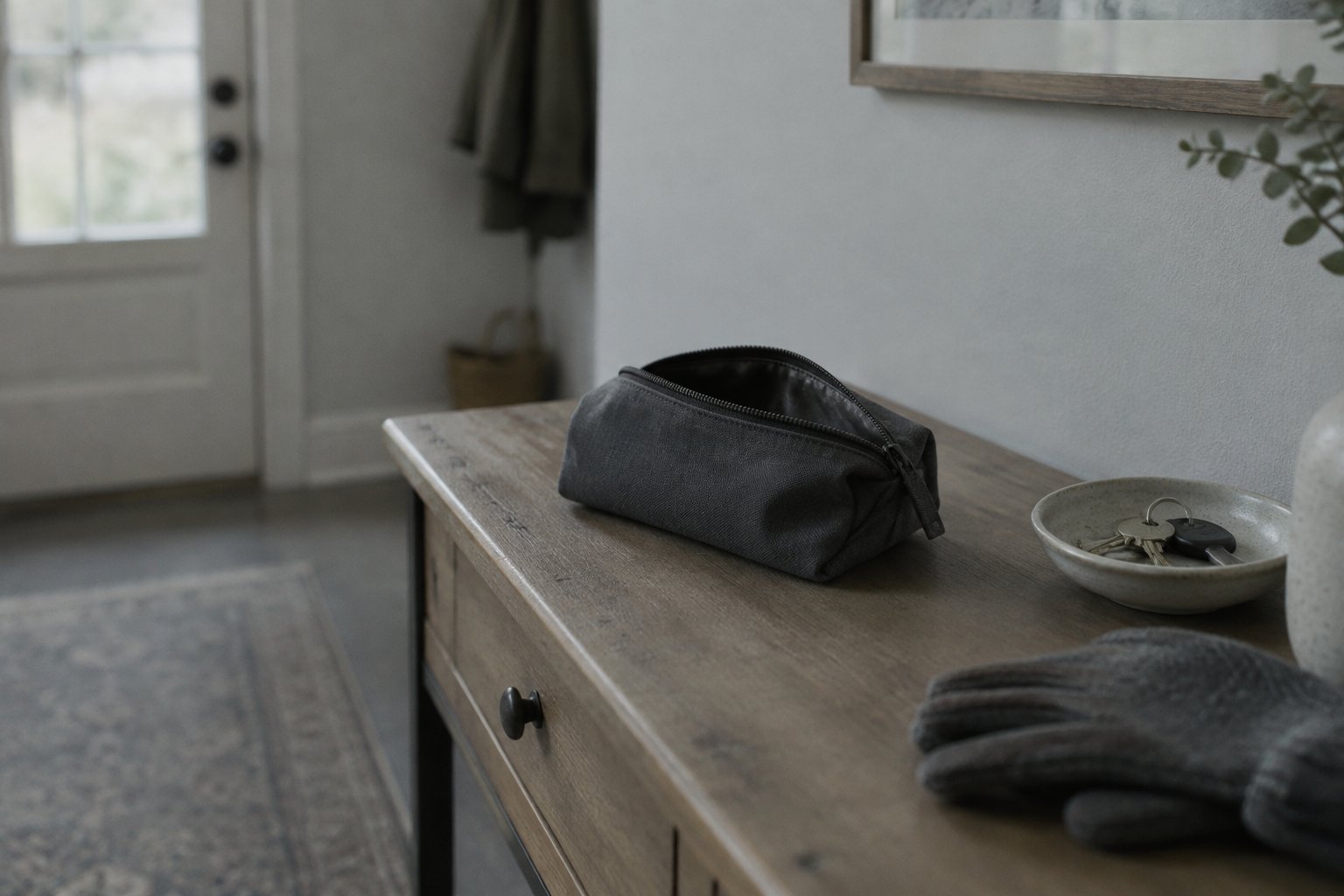
A Faraday bag does one job: it cuts your phone, key fob, or cards off from radio signals while they are sealed inside. That covers cellular, GPS, Wi-Fi, Bluetooth, RFID, and NFC. For everyday privacy, it is the only way to be sure a device is silent, as long as the bag works and you close it correctly.
The catch is that many pouches leak. A worn seam, a sloppy roll-top, or thin lining lets signal through, and nothing on the outside tells you. Your phone also keeps collecting data while it sits in the dark, then uploads it when you take it out.
Used well, a bag breaks the link between your device and your pattern of life at the moments you choose. If you already own one, run a call test on it tonight before you trust it with anything that counts.
Key Takeaways
- A sealed, tested bag stops your devices from talking to towers, networks, and readers.
- A phone call into the sealed bag is the fastest check, and it needs repeating as the bag wears.
- Build quality and closure design separate working bags from cheap ones, not marketing claims.
When Does Signal Isolation Improve Everyday Privacy?
Signal isolation helps most when you want proof that a device is quiet at a specific place and time. It does not erase tracking that already happened, and it does not stop what the phone records on its own.
When Should You Isolate Your Phone Instead of Using Airplane Mode?
Use the bag when you need certainty. Airplane mode is a software setting. Your phone’s radios are controlled by software switches, not a physical kill switch, so you cannot confirm the phone has stopped transmitting.
In professional counter-surveillance work, the rule is simple: a device that goes to a sensitive location either stays behind or is physically isolated well before arrival. Trainees learn that the phone’s trail starts long before the meeting, on the drive and in the parking lot. The civilian version breaks down when people bag the phone at the door, after the device has already logged the route.
Bag the phone before you leave a known location, not when you arrive.
Which Signals Can a Properly Closed Bag Block?
A sealed bag in good condition blocks the main radios in your carry:
- Cellular voice, text, and data
- GPS reception
- Wi-Fi and Bluetooth
- NFC and RFID for cards, badges, and passports
That makes it a solid fit with your other EDC electronics. It also protects against data theft through short-range skimming, since readers cannot reach a card inside the shield.
What Tracking and Data Collection Can Continue Offline?
Your phone keeps working inside the bag. It runs apps, stores motion sensor data, and can log events. When you open the bag, queued data syncs.
Time gaps also tell a story. A phone that drops off the network at the same place every week creates a pattern of its own. Cameras, license plate readers, and payment records work regardless of your phone. Radio habits matter too; for example, ham radio traffic is traceable in ways a bag cannot fix.
When Does a Key Fob Pouch Make Sense?
A fob pouch makes sense if your car uses passive keyless entry, where the car unlocks when the fob is nearby. Relay theft extends the fob’s signal so the car thinks the key is close. Keep the fob in a pouch overnight and in places where people can get near you unnoticed, such as parking garages and other transitional spaces.
How Do You Test a Bag Before Relying on It?
Test every bag with your own devices, in a strong signal area, before you depend on it. Cellular is the hardest signal to block, so start there, then check Wi-Fi, Bluetooth, and the fob on their own.
Establish a Connection, Seal the Phone, and Call It
- Stand where your phone shows full bars.
- Seal it fully, following the closure design (all rolls or folds).
- Wait about a minute.
- Call it from a second phone.
A working bag sends the call straight to voicemail. Any ring means a leak. Send a text too; it should only arrive after you open the bag.
Check Wi-Fi and Bluetooth Separately
Start a video stream on Wi-Fi, then seal the phone. Playback should stop within seconds. Next, play music to Bluetooth earbuds and seal the phone again. The audio should cut out and the earbuds should start searching. If your router shows connected devices, confirm the phone drops off the list.
Run a Key Fob Test Beside Your Vehicle
Seal the fob and stand next to your driver’s door. Pull the handle and press the start button if you can reach it. If the car unlocks or starts, the pouch failed. Test from the trunk side too, since antenna placement varies.
Repeat Tests After Wear and Closure Problems
Conductive fabric cracks with folding, friction, and moisture. Retest after the bag gets crushed, wet, or snagged, and on a regular schedule if you use it daily. Keep the bag in a dedicated slot in your tech organizer so keys and pens do not wear holes in it.
What Separates a Reliable Bag From a Cheap Pouch?
Construction and proof separate them. A reliable bag has a closure that overlaps the shielding, sealed seams, and layered lining, and the maker shows how it was tested.
Inspect Closure Overlap, Seams, Fit, and Lining
The closure is where most bags fail. Look for a roll-top or a lined flap that folds the shielding over itself more than once. Check that the inner lining runs all the way into the seams with no gaps. Pick a size that fits your phone with a case, because a tight fit stops the closure from sealing. Several layers of faraday fabric under a tough outer shell hold up better than one thin layer.
Compare Shielding Evidence, Not Brand Promises
Shielding is measured in decibels across frequency bands. Ask for test data that names the bands and the method. A big number printed on a label with no detail tells you little. Even with good data, your own call test decides whether your copy of the bag works.
Separate EMP Protection Claims From Everyday Signal Blocking
EMP protection and pocket privacy are different problems. Military hardening standards for electromagnetic pulse cover facilities and systems, not soft pouches you open daily. A pouch that blocks your phone’s radios proves nothing about pulse survival. If that threat concerns you, look at storage and planning such as protecting your vehicle from an EMP.
Understand the Limits of a DIY Faraday Bag
A DIY Faraday bag made from foil or a metal tin can pass a call test on a good day. It fails once foil tears, a lid loses contact, or the wrap loosens. It is fine for an emergency or a one-time test. For daily carry, it is too easy to damage without noticing.
Carry a Bag You Can Verify
A faraday bag only improves your privacy if you have proven it blocks signal. Bag your phone before you leave a known place, test the bag on day one and after any damage, and treat the closure as the part most likely to fail. Pair signal blocking with other habits, such as encrypted communication, for parts of your footprint the bag cannot touch. When you fly, pack it so it passes inspection easily alongside the rest of your TSA-friendly EDC kit.
Frequently Asked Questions
Can your phone still be tracked inside a Faraday bag?
Not by radio while the bag is sealed and working. The phone can still log data offline and upload it later, and your location shows up through cameras, cards, and the place where the phone went dark.
Is carrying a Faraday bag legal in the United States?
Carrying one for personal privacy is generally legal. Using one to hide evidence or obstruct an investigation is a separate issue, so check with a lawyer about your situation if that question applies to you.
Can aluminum foil replace a Faraday bag?
Only for short-term or emergency use. Foil tears and loosens easily, so it leaks without warning. Test any foil wrap with a call before you trust it.
Will a Faraday bag stop every kind of keyless car theft?
No. A signal-blocking pouch stops relay attacks on the fob, but it does nothing against other methods such as break-ins or attacks on the car’s own systems. Use it with normal habits like parking in lit areas and locking a garage.
Can a phone record audio while inside a Faraday bag?
Yes. The bag blocks signal, not the microphone, so the phone can still record. Anything recorded cannot transmit until the phone leaves the bag.