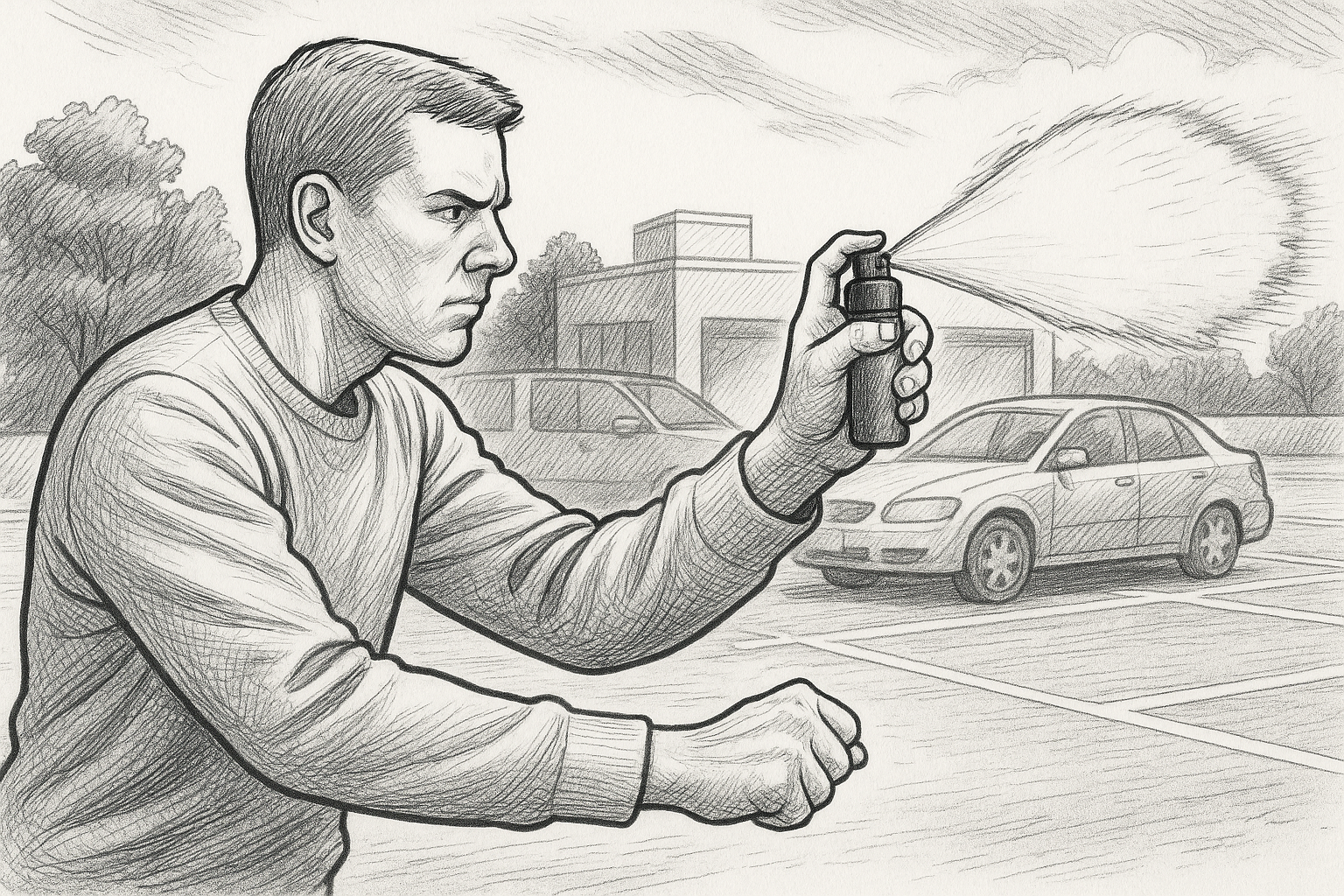
Most people who carry pepper spray have never actually deployed it. They bought it, clipped it to a keychain, and assume that when the moment comes, they’ll figure it out. That’s not a plan.
OC spray is one of the most accessible and effective personal defense tools available. It’s compact, legal nearly everywhere without a license, doesn’t require significant strength to use, and stops most attackers. It also requires practice, a clear carry position, and at least one conscious decision before you can use it effectively. Here’s what you need to know to carry it properly.
What it does
Oleoresin capsicum causes immediate, intense burning in the eyes, skin, and mucous membranes. The eyes involuntarily close. Breathing becomes difficult. Most subjects are disoriented and incapacitated within 10 to 20 seconds and remain affected for 30 to 45 minutes.
It doesn’t work on everyone. People under stimulants, those with extreme pain tolerance, or someone highly motivated can push through it. OC spray is not a guarantee — it’s a force multiplier and a time buyer. That time is for you to create distance and disengage.
Is it legal where you are?
Most U.S. states allow civilians to carry OC spray with minimal restrictions. A few have specific requirements worth knowing:
Massachusetts: Must purchase from a licensed firearms dealer.
New York: Must buy from authorized in-state retailers; no online or out-of-state purchases.
Hawaii: Restricted — check current statutes before purchasing.
California: Maximum 2.5 oz canister; prohibited for felons and minors.
Illinois: Must be 18; restrictions near schools.
Washington D.C.: Legal to carry; registration requirements may apply.
A handful of other states have restrictions on canister size or concentration. Check your state statutes before you buy. Most civilian carry is unambiguously legal.
Choosing the right product
Concentration. Look at major capsaicinoids (MC), not Scoville units. Scoville is a marketing number. The effective measurement is MC percentage. Sabre Red runs at 1.33% MC and is consistently rated as one of the most reliable civilian options. UDAP and Mace also produce quality civilian formulations.
Delivery pattern. Cone spray creates wide dispersal and doesn’t require perfect aim, but it’s vulnerable to wind and blowback. Stream pattern reaches 12 to 15 feet and is more resistant to blowback. Gel pattern has the least blowback risk but requires more accuracy. For most people carrying in urban environments, stream is the best balance of range and control.
Canister size. A keychain canister is better than nothing, but a 2 to 3 oz unit gives you more volume and more follow-up shots if the first deployment doesn’t stop the threat. Carry the largest size that fits your daily setup.
How to carry it
Buried in a purse or backpack is not carrying it. If you need it, you need it in under two seconds.
Clip-carry units like the Sabre Red Clip-On or the POM Compact attach to a waistband, belt, or bag strap and keep the canister accessible without digging. Practice the draw: pull it out, put it back, repeat until the motion is automatic. Your hands should know exactly where it is without looking.
Keep it on your non-dominant side if you also carry a firearm, so you’re not reaching for the same position under stress. Make the carry location consistent — same side, same position, every day.
Deploying it effectively
The most common mistake is deploying at too short a range. OC spray is effective between 6 and 15 feet. If someone is already within arm’s reach, you’ve waited too long.
When you deploy: aim for the face, move laterally as you spray, and keep moving after. The goal is to create distance, not to stand and watch the effect. OC spray is a tool to break contact and disengage — not a finishing move.
After deployment, you and anyone nearby may experience secondary exposure. Don’t rub your eyes. Use water to flush — not milk, not anything else. Move upwind.
Practice before you need it
Buy a second canister of the same model and use it for training. Draw it from your carry position, aim at a target, work the motion until it’s fast and clean. Inert training canisters are also available if you want to practice in an enclosed space.
One canister sitting on your keychain for three years is not proficiency. Carry it consistently, know how to access it, and understand what it does and doesn’t do. That’s the difference between carrying it and actually being prepared to use it.