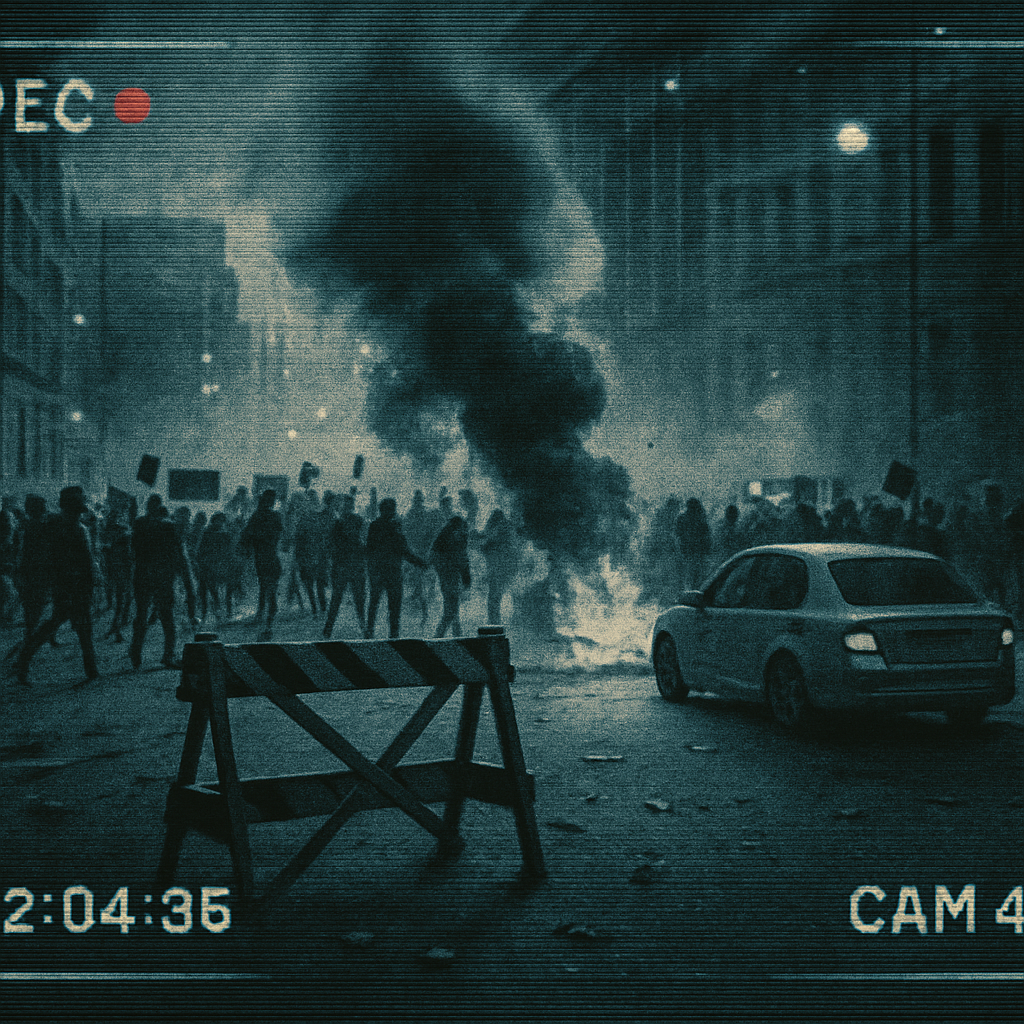
When unrest breaks out, movement is one of the first things you lose. Roads close. Freeways lock up. Protest zones expand into adjacent neighborhoods without warning. If you’re downtown, near a federal building, or in a commercial district when things start, getting out may not be as simple as walking to your car.
Most people plan their route to work once and never think about it again. That’s fine in normal times. During civil unrest, a route you’ve driven a thousand times can disappear in under an hour.
What buffer zones actually are
A buffer zone is the space between you and the problem. It can be physical distance, a building, a block of streets, or a neighborhood you’ve pre-identified as stable. The goal isn’t to predict where trouble will start. The goal is to recognize it early enough that you can create distance before you’re inside it.
The mistake most people make is waiting for confirmation. By the time there’s a video clip or a news alert, the perimeter has already expanded past where you needed to be moving. Decision-making in these situations happens on incomplete information. You’re better off leaving early and being wrong than staying until you’re certain and being trapped.
Planning multiple exit routes
Your primary route home is the one you use every day. Your secondary is the one you use when your primary is blocked. Your tertiary is what you use when you don’t know what’s happening and you need to move away from the problem without crossing it.
Most people have a primary and nothing else.
For your work location, your regular destinations, and anywhere you spend significant time, map at least two alternates. Know which ones avoid downtown corridors, freeway on-ramps, and major intersections. These are the first points to lock up during civil unrest. Side streets, residential routes, and routes that keep you moving away from commercial and government districts will stay open longer.
Do this on paper or in an offline map app. Phone data gets unreliable in high-density emergency situations.
The bailout decision point
A bailout is when you abandon your original plan and move to secondary options. Knowing when to make that call in advance is what separates the people who get out from the people who get stuck.
Set a mental threshold before you need it. If you hear sirens from two or more directions, if you see a crowd forming and moving toward you, if your normal route home is already blocked — those are decision points to go to your alternate, not cues to sit and wait. Delay costs you options. The further unrest spreads, the fewer routes remain.
Gear for mobility
You don’t need a full bug-out kit to handle a mobility scenario. You need a few specific things in your vehicle at all times.
Keep your tank above half. Fueling stations near unrest zones get overwhelmed fast, and you may need to route around a significant area of the city.
Download offline maps for your city and surrounding counties before you need them. When cell networks are congested, your downloaded maps will still work. Google Maps and Maps.me both support offline downloads.
Keep $60 to $80 in small bills in your center console. Card readers fail and tolls may be your fastest option on an alternate route.
A change of clothes in your trunk is a low-effort, high-value item. If you’re in professional dress and need to move through a different environment, having an option matters.
Your vehicle should carry water, a light, a basic medical kit, and a phone charger as baseline daily gear. Not emergency supplies — standard vehicle carry.
Communication during movement
Know where you’re going before you leave. A quick text saying “leaving downtown, taking the river road route” takes 10 seconds and means someone knows your plan if you don’t arrive on time.
Check local scanner apps or emergency management alerts before you move. The goal is to route around the problem, not into it. Cell service can degrade in high-activity areas. A HAM radio or a NOAA weather radio gives you independent access to information when other networks are strained.
The principle
Distance is the most reliable form of protection. Create it early. The people who handle these situations well aren’t necessarily better equipped — they made a decision faster and moved before their options closed.
Plan your routes now. Put the maps on your phone. Keep the tank full. When the time comes, you’ll execute a plan you already made rather than figuring it out in traffic.